Berlin Diary, Week 1
Tripping on history.

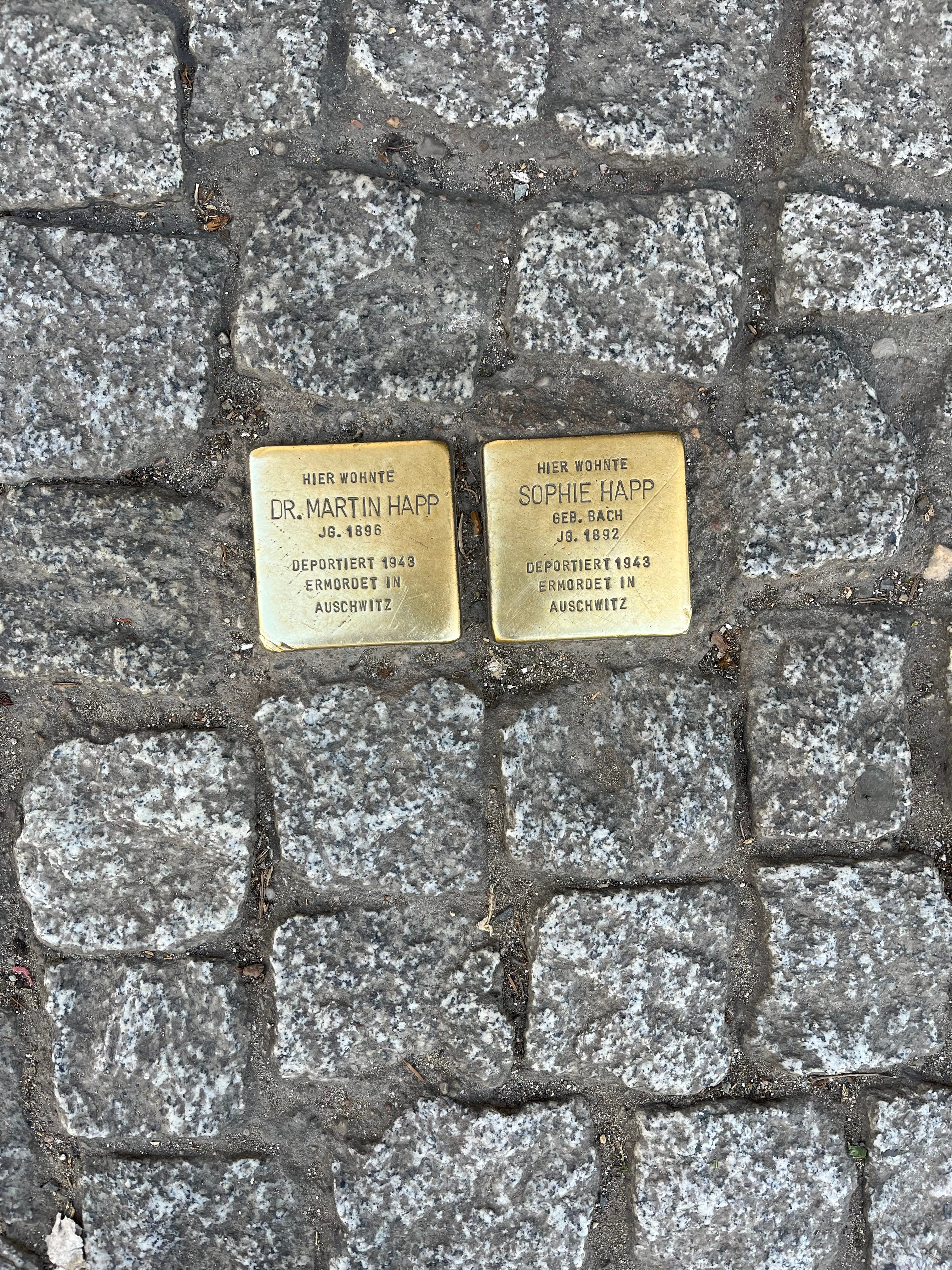
I’ve been in Berlin for a week, working out of the Times bureau. It’s been almost 16 years since I last lived here, and the city has certainly changed. Boy, has it gentrified. It is cleaner, but also bougier. Everyone complains about housing. Rents in Mitte, where I am staying, are comparable to parts of Manhattan, and buying a nice one-bedroom can easily set you back $1 million. It also feels closer to complete, in the sense that the fall of the Wall and reunification jumpstarted a multi-decade rebuilding that turned Berlin into Europe’s largest construction site. If anything, the end of that era of constant building is a bad thing — because, again, housing.
One thing that has not changed, though, is the city’s sense of its own history, warts and all. On my walk to work I pass two sets of Stolpersteine, or stumbling stones, bronze squares marking where Jews murdered during the Holocaust once lived. The ones closest to my apartment commemorate Dr. Martin Happ and his wife, Sophie, who were killed at Auschwitz. The squares sit slightly higher than the pavement stones around them, so that passersby might literally stumble upon a piece of Berlin history.
The project has been enormously successful, and it has spread far beyond Berlin. According to the official Stolpersteine website, there are some 107,000 placed in 1,900 communities. I’ve seen them in Rome, where they cluster around what was once the Jewish ghetto. Almost 20 years ago, organizers introduced Stolperschwellen, or stumbling thresholds — broad rectangular blocks that memorialize places like synagogues or yeshivas, where, again according the website, thousands of individual Stolpersteine might have been necessary.
It’s easy to look at these, and the absence of anything similar in the United States, and conclude that Germans are better at embracing their shameful past better than we are. And that’s not wrong, I don’t think. But there’s more to it. These aren’t passive markers. They are interactive, in an intimate way. They gently disrupt your train of thought, in a way that is both insistent and humane. Only a society that has a deep engagement with its members’ humanity and confident that they will react appropriately would try such a thing. Berlin is full of similar small interventions that add up, like bricks in a wall, to a kinder, gentler, more resilient community.
There’s something else about the Stolpersteine, though, that makes me uneasy. By a long country mile, my favorite monument in Washington is the Vietnam Veterans Memorial. Such a simple, powerful gesture. I can’t visit it without tearing up at its awesome, silent presence. And yet one reason I respect Maya Lin’s creation is that I’m not sure what it’s trying to say. On the one hand, it is a gash in the earth, a permanent disfigurement of the National Mall alongside such stately bombast as the Washington Monument. But it is at the same time a beautiful, serene place, an improvement on the same land that it interrupts (and, in that way, an appealing tourist attraction). It artfully aestheticizes even as it boldly memorializes. To me, this is its true power: It shows that only by recognizing history in its rawest form — a long list of the dead — can we form a more perfect future. (I think the Ground Zero memorial in Lower Manhattan comes close to the same, as does the USS Arizona memorial in Hawaii.)
Stolpersteine do something very similar. They invite you to engage with the worst of human history, one name by one name, even as they are also pretty little flecks of gold in an otherwise gray sidewalk. And in that tension they remind us that engaging with a shameful past is not about eternal damnation in the present; rather, it is the only way that we can all move ahead to a better future.